Friday, 6 September 2013

Keel hardwood and stern tube fitting

First thing to organise was the keel wood.  11 pieces of 150mm x 75mm kwila that were 3600 long.  These things were VERY heavy, craned off the truck but then carried in one at a time by me.  Hope the strong back lives up to its name!


I mentioned in the last post the stern tube I am fitting through the keel.  First step was to mark on the hull where the shaft line hit the hull using the drawings.  Then I started dry fitting pieces until the tube was supported from the hull to where the propeller will be.  From the inside I drilled up for the temporary threaded rod.

I used a piece of PVC pipe the same diameter as a guide as I carefully chiseled out a sloped hole through the glass/ply hull.  Once through and widened until the pipe fit (required inside and outside work so I didn't destroy the inside ply face)  I found it was going to pass through the hardwood cross piece on the bottom of frame 8.  Once I had made a start I drilled a 10mm hole through the hardwood using the sloped cut as a guide so I could work from both sides of the hardwood.  After much time and repeated climbing from inside to out and back again I could slide the 2000mm pipe up from the inside.

Below is a shot showing the slot in the hull as I pushed the tube out from the inside:


And an overhead shot showing the pipe lying (hopefully) on the centre line of the keel and into the hull:


A side shot of the same, my drilling of the holes was a bit angled and cramped inside of the frames.  If necessary I will cut off the rod as the keel gets higher and drive some drifts (I think they are called) from the top down as these rods will be permanently epoxied into the keel:

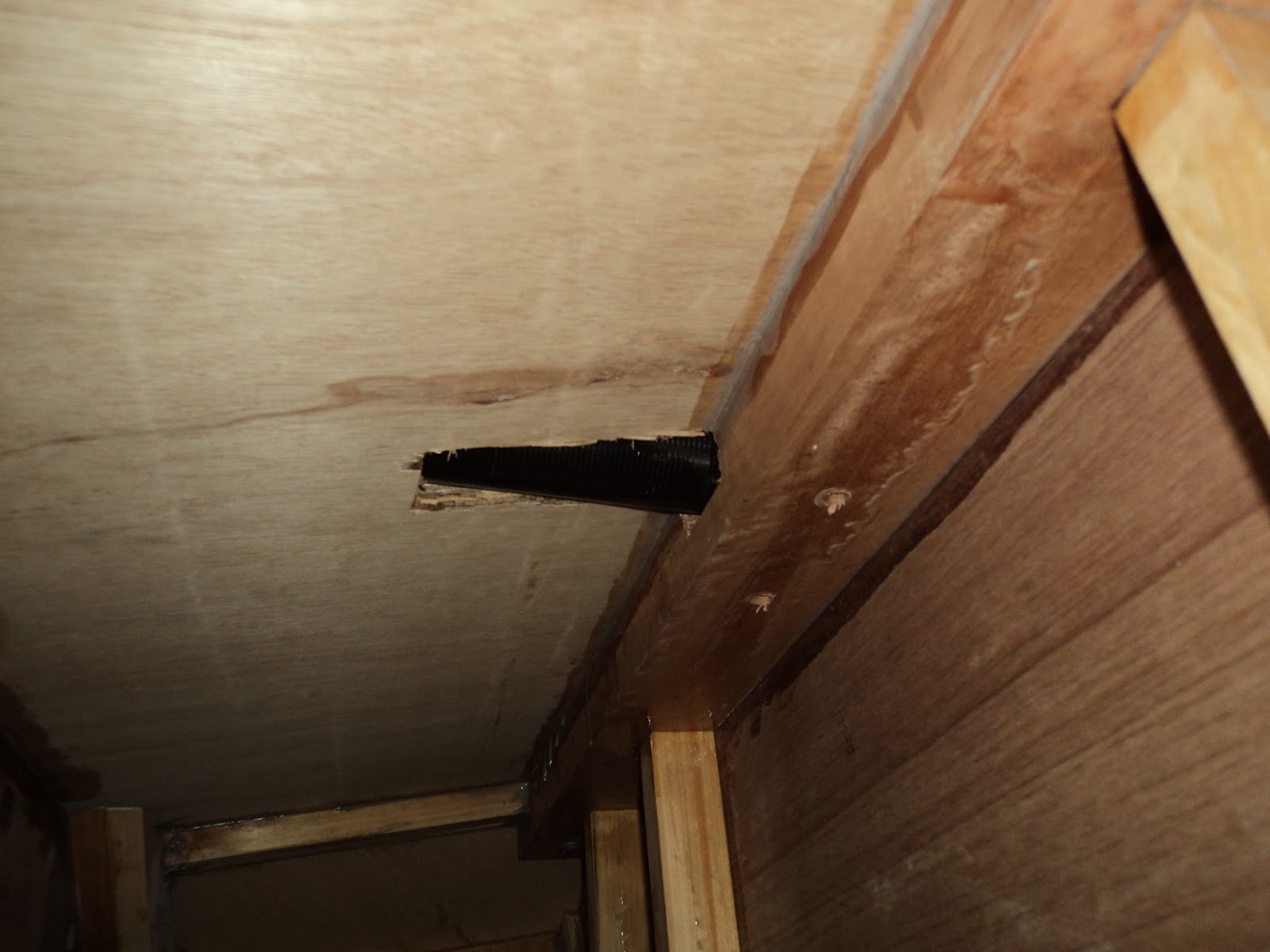

An inside shot from the side showing the path of the tube through the hardwood on frame 8.  It is probably not needed but because I have cut some of the cross piece out I am going to put an extra piece of hardwood across the centre line 300mm each side to spread the load from the bolts.  Basically epoxy/coach bolt a doubler of hardwood over the top:


And a slightly out of focus shot showing the engine end of the stern tube sitting over the top of frame 7:


Next is to build wooden supports on the inside of the hull where the pipe is located so when the whole thing is epoxy/glued in you can fill the whole lot up.  That will be in the next post along with epoxy/gluing the first bit of the keel in place first.

Friday, 23 August 2013

Stem cap and keel holes

After plenty of looking at the inside, measuring, checking with a plumb bob and marking it was time to drill holes up through the frame hardwood cross pieces and through the bottom of the hull.  I also ran a string down the centreline on the outside and marked it with permanent marker.

The keel will be 150mm wide hardwood, the most important holes are the ones in frame nine and ten which will pass each side of the fibreglass tube the propeller shaft will run through.

Below is a picture of the fibreglass tube, 50mm external circumference:


Also made up a template of the keel, I am thinking steel keel box filled with lead ingots at this stage:


Took some deep breaths, used a square and the frames to try and get the holes as vertical as possible and drilled them.  Ones at the front and where the keel will go are 10mm, down the aft 8mm.

Frame 2 10mm hole:


The stem was laminated at the start of the build and incorporated into the hull with stringers and finally planking.  Now that the sides are done it was time to cover it with hardwood and continue it up over the bottom where it will meet the keel.  I got 90mm wide strips delivered, plan called for 5 x 5mm but my supplier could only do 8mm.  Final result is still 24mm or just short of an inch thick so I think it will be okay.

A piece of hardwood was needed to fill in a space where the ply bottom finished (had to meet a hardwood cross piece at the other end of it).


Nails were removed once dry, the front (left as you look) planed down to an angle.  Managed to plane a bit off the end of my finger but only minor.  Made me pay attention though, it has been a while since I used the electric plane.  Then the first layer went on.  Started to pull down the high end to the right angle, snapped it in half at the bend.  After a panic attack I realised I would have to use the snapped piece in the middle of the three.  I had previously seen on the woodenboat forum (where I get all my boat building advice from!) about bending wood.  Marked each end of the curved area, wrapped it in a hand towel and poured boiling water over each side and let it sit.  After a few minutes while still hot bent it around the curve, screwed in place and left it for the epoxy/glue powder to set.  Worked a treat.
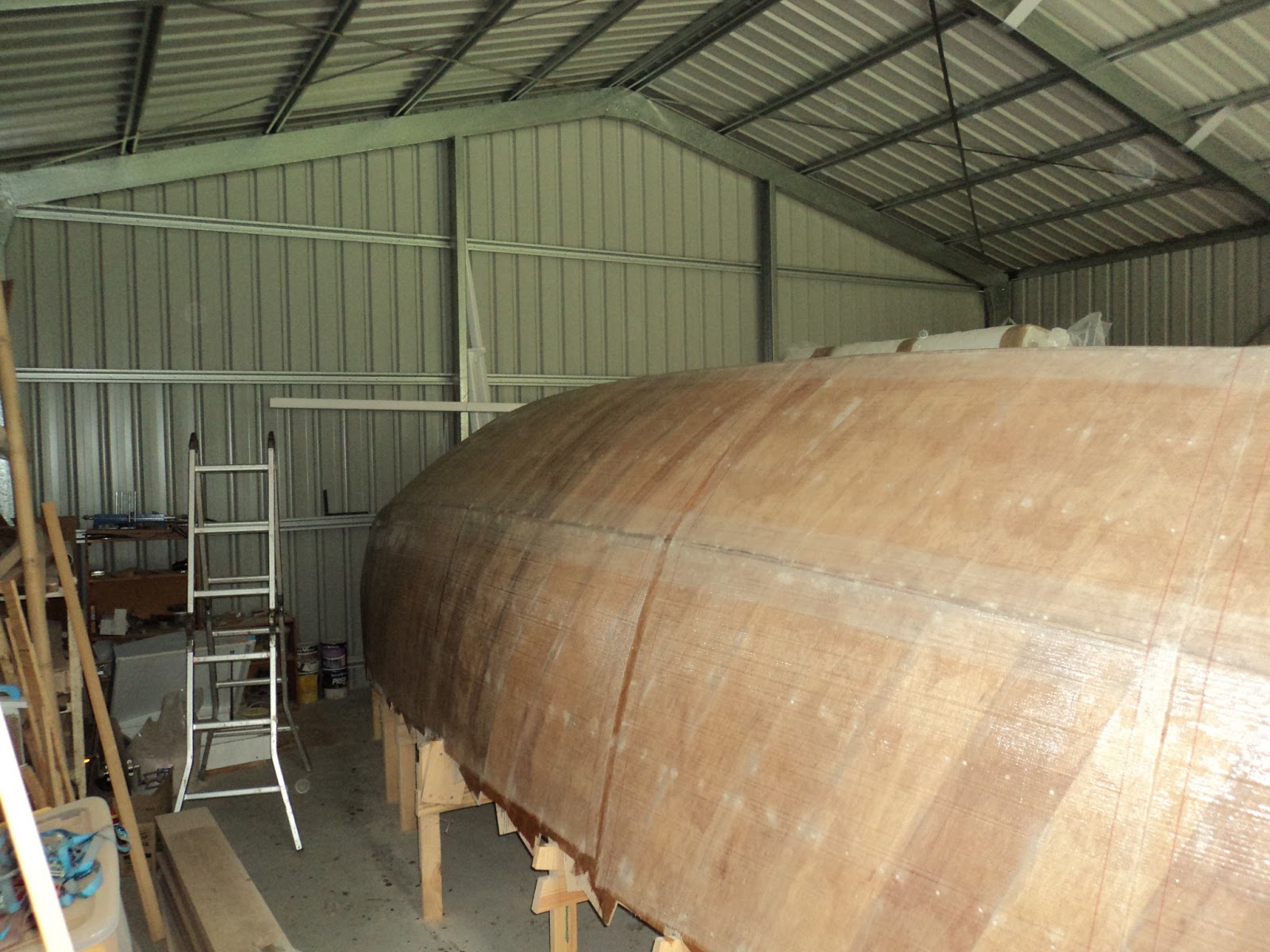

Cut a fill in piece of hardwood to fit on top of the first to support the cap, pulled it down with a strap and the second layer went on in two bits, join is about half way so that the curve and top is one piece.  Wrapped some cling wrap over where it will be layered into the keel, you will understand later.


Then the final piece:


And in close up, note the extra hardwood packing piece:


Filled the screw holes (screws were removed once each layer had set and re used so there are no screws in the cap anywhere) and blended the hull join with filler powder.  Checked my drawings and plans, and cut off the cap.  After a bit of sanding and clean up this is the result:


Close up, the cut out bit is where I had the cling wrap so the first and second layer would not stick together:


Cap to hull filled and sanded:


And looking back along the hull.  Don't worry about the lean on the back threaded rods, it is 8mm rod in 10mm holes so there is a lot of movement.  The first one is 10mm rod in 10mm hole and is standing nearly perfectly.  I am sure they are not perfectly level each direction though I must admit.


Fairing part two

Once I was sick of the first side I started on the second.  It didn't seem as bad and I think some of my early coats on the first side were too thick and ran so much that I was just wasting epoxy/filler, time, energy and sanding paper.

The second side seemed to benefit from the early mistakes.  If you remember on the bow I tried to use a notched spreader to make grooves with only partial success.  After sanding and filling I stuck with the thin coat, sand, recoat process which seemed to work okay.  Maybe I was just over it and decided it was good enough.  I have moved on to the keel prep and start (next post shortly) and haven't taken any shots of the second side.  It looks like the first, see below for the final outcome.  I may go back as I work on the keel and do small spots if they bug me, but we will see.

Looking down the first side after final sanding:


Looking from the side at the transom towards:


Looking aft at the top curve:


Lastly looking aft bottom curve:


Next post will be prep for the keel with holes drilled through the bottom and building the hardwood stem cap.

Thursday, 1 August 2013

Fairing part one

Had a few computer problems so have not updated for a while.  The fairing of the hull continues, this would have to be the worst part so far but I am getting there.

After the first layer of epoxy/filler powder was dry I started.  First I made a sanding board so I could sand the curves.  These are also known as torture boards, and with good reason.  The ply is 6mm so I can bend it around the curve, I cut slots near each end to feed in sandpaper from a roll and screwed extra ply on top to hold it in place.  Couple of handles screwed on and away I went.  The idea is you sand in different directions/angles and the bend in the ply stops you sanding flat spots because it will take the curve of the hull as you press in on the handles.


I also have another sanding block similar to a bricklayers trowel with a handle, very useful as well.

Although I thought the hull was quiet smooth I soon discovered all the little dimples in the hull.  The pattern of the fibreglass mat, even though I coated it a number of times, was still there.  I tried using a notched spreader with the epoxy, the idea being you sand it hitting the high points and then fill in the hollows.  I didn't mix the epoxy thick enough and it ran together instead of leaving peaks.  Luckily I only did the front on one side as an experiment.  I'll let you know because it is on the second side I've just started. 

After starting sanding the entire hull and putting on a second coat I decided to work on a single side at a time for my mental health.  That way I could see progress as I did each coat.  I have left the bottom until after I have made the keel.

This the side I did first after sanding:


The other side:

The next coat going on:


Sanding and re-coating a couple of times I found a thin layer scraped with a wide plastic spatula was better than doing thick coats which ran and needed lots of sanding.  This is the front:


And looking towards the transom:


I still have a few spots to sand after today, I had a bit of mixture left over so went back to a couple of small hollows.  The above photo was when it was still wet, the shine goes with the final fine sand.


The other side which I am now working on, this is early sanding:


 And the most recent layer today:


And looking towards the transom:


I will continue on sanding and layering, and will continue with the next post including final shots.  But this takes a while!

Thursday, 20 June 2013

Bottom fibreglassed and prep for fairing

Don't get too excited.  I have done quite a bit of work on the boat, but unfortunately other than denting my boat fund it doesn't look too much different.

With the sides fibreglassed and one coat of epoxy on them I cut the mat for the bottom.  I had continued the side mat up over the side/bottom join and onto the bottom a bit, so cut the mat to overlap that but not go all the way out to the side.  I worked front to back in a single sheet and trimmed it carefully from on top of the hull.


Mixed a big lot of epoxy and spread from the front working back, carefully climbing down to mix more as I went.   Was not too bad as the almost flat surface meant the epoxy didn't run like it did down the sides.  Below is after fully wetting out.


And a close up looking across the bottom from the ladder you can see above left:


I left it overnight and when I came back gave the sides and bottom a light sand, then coated them again with epoxy using the roller.  I did the sides first (I had a plan) and then stood on the ladder and did the bottom with a piece of wood jammed into the roller as a handle.  You can see it leaning on the saw horses above.  By the time I had done both sides, then the top (with numerous epoxy mixes) the sides were tacky so I could put a third coat on them.

I wasn't sure if I needed a third coat on the bottom so stopped.  When I came back it turns out being flat I had put two good coats on it so the weave of the mat was fully covered, as it now was on the sides.

I cannot believe how much epoxy I used, I seemed to have empty 4 litre bottles everywhere.  Had to make an emergency trip to Boatcraft Pacific to stock up.

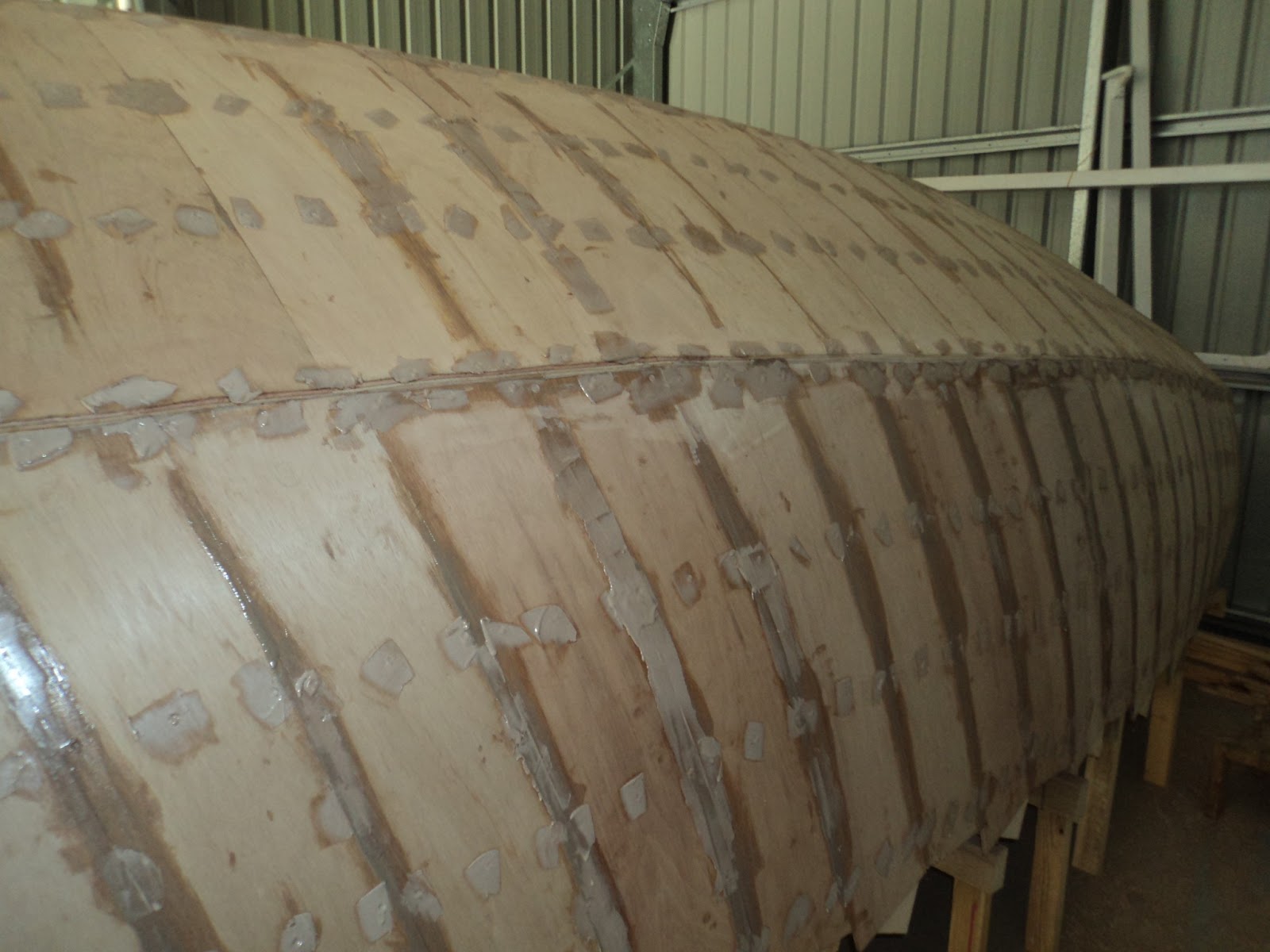
In preparation for fairing (sanding to make sure the surfaces are even and smooth) I mixed epoxy with light filler powder and spread it all over both sides using a 4mm notched tile adhesive spreader.  My initial mixes were a bit runny, but this is only the first coat and once a bit of sanding has been done I will have to fill any low spots anyway.

Below is an overhead shot while the sides are still wet.


And one from the side.  It looks a lot more uneven than it actually is, but once it is dry I will take some more photos before I start sanding.


Sunday, 9 June 2013

Sides fibreglassed

Managed to get both sides fibreglassed over a few days.  Prep required standing on the top and unrolling the mat so that I could cut to length.  The sheet is a bit over 1200mm wide, it is 450 gsm biaxial  which you drape down the sides, and overlap up onto the bottom over the tape along the side/bottom join.

Below is a photo of cutting one piece to length, I marked vertically with pencil on the hull so I knew where to put the epoxy prior to fitting.


The first day I did all the full sheets on one side, but I only had a very narrow roller so putting on epoxy was like painting a house with a one inch brush.


A quick trip for some throw away big rollers and I was in business.  I cut the sheets for the other side and the ones for front and back which I left on the first day.  Those ones were put on oversize and then trimmed once placed on but before fully wet out.

First step is to apply epoxy to the area to be covered:


Then carefully position the sheet, and apply more epoxy towards the edges ensuring there were no creases.  This thing took a LOT of epoxy to wet out the sheets.  I found putting a thick layer on the wood helped hold the mat in place, but you had to get it in position well before you pressed it on with your gloved hands.  You will see on some of the side shots that there are gaps between the edges, some bigger than others.  Due to the shape I decided just to get the edges as close as I could without overlapping them as this would then have to be sanded down.  I figure it will have two more layers of epoxy, then extra layers when I fair it so those little spaces will be well protected.

End results:

From the side, the front is the one you can see me putting epoxy on in the above photo.


Other side front:


Same side looking towards the transom:


And a front on shot.  Still have the bottom to glass:


As I said, glass the bottom, then it is time to put on a few coats of epoxy.  After that comes a couple of coats with light filler and sanding until my arms fall off.

Thursday, 6 June 2013

Hull prep and joins taped

Once the final piece of ply was on the bottom it was time for more trimming.  Ran the electric plane along the join between the sides the the bottom and gave it a bit of a sand to a curve in preparation for fibreglass taping the joins.

Before that I had to mix up epoxy and light sanding filler and fill every screw hole in the hull.  Lets just say that took a while, much like using a putty knife when getting ready to paint a wall.

Below is are two side shots of the dry filler before I sanded them all down to make them match the hull, another arm killing job.


Then it was time to see how the fibreglass taping would go.  The tape is 200mm wide 420 gsm biaxial and I cut four lengths, one for each chine 6.1m long:


And carried the roll up onto the top of the hull and lay it down on the bottom/side join and cut to length:


To apply the tape, paint epoxy onto the hull full width of where the tape will go, push the tape onto the epoxy (which will hold it without any other support) then go along with a brush and foam roller in one direction pushing towards the outsides to ensure the glass is fully wet out.  Ensure there is not too much epoxy which will cause it to float above the wood (apparently, just learnt that from BoatCraft Pacific's epoxy building pamphlet!).

This is the first chine join done:


Looking side on:


I did both sides, then took my scales and epoxy up on top so I could mix as I went without getting down.  I thought the chines would be harder, but I actually found the bottom/side join worse when working on top.  I was surprised the epoxy would hold the tape while I finished it, making it easy to walk along from rear to front as I went.

Finished shots, overhead from the front looking back:


Close up of the side/bottom join where the stem cover piece will come up over:


The second side looking to the transom:


Final shot looking from the transom forward, sorry it is dark but I had to shut the door due to back lighting:


Next is to glass the whole hull, that should be fun....