Thursday, 30 May 2013

Second layer on the bottom

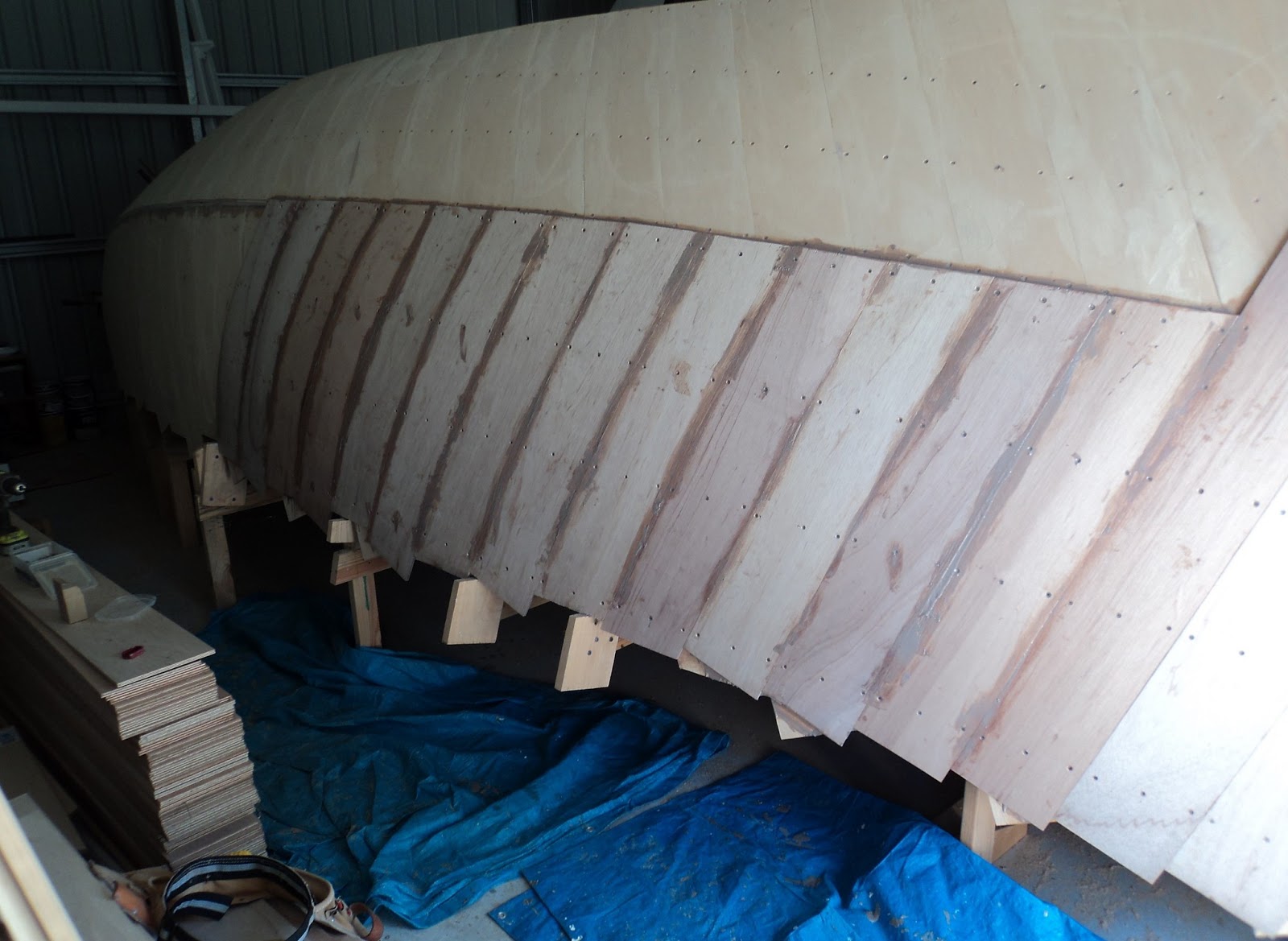
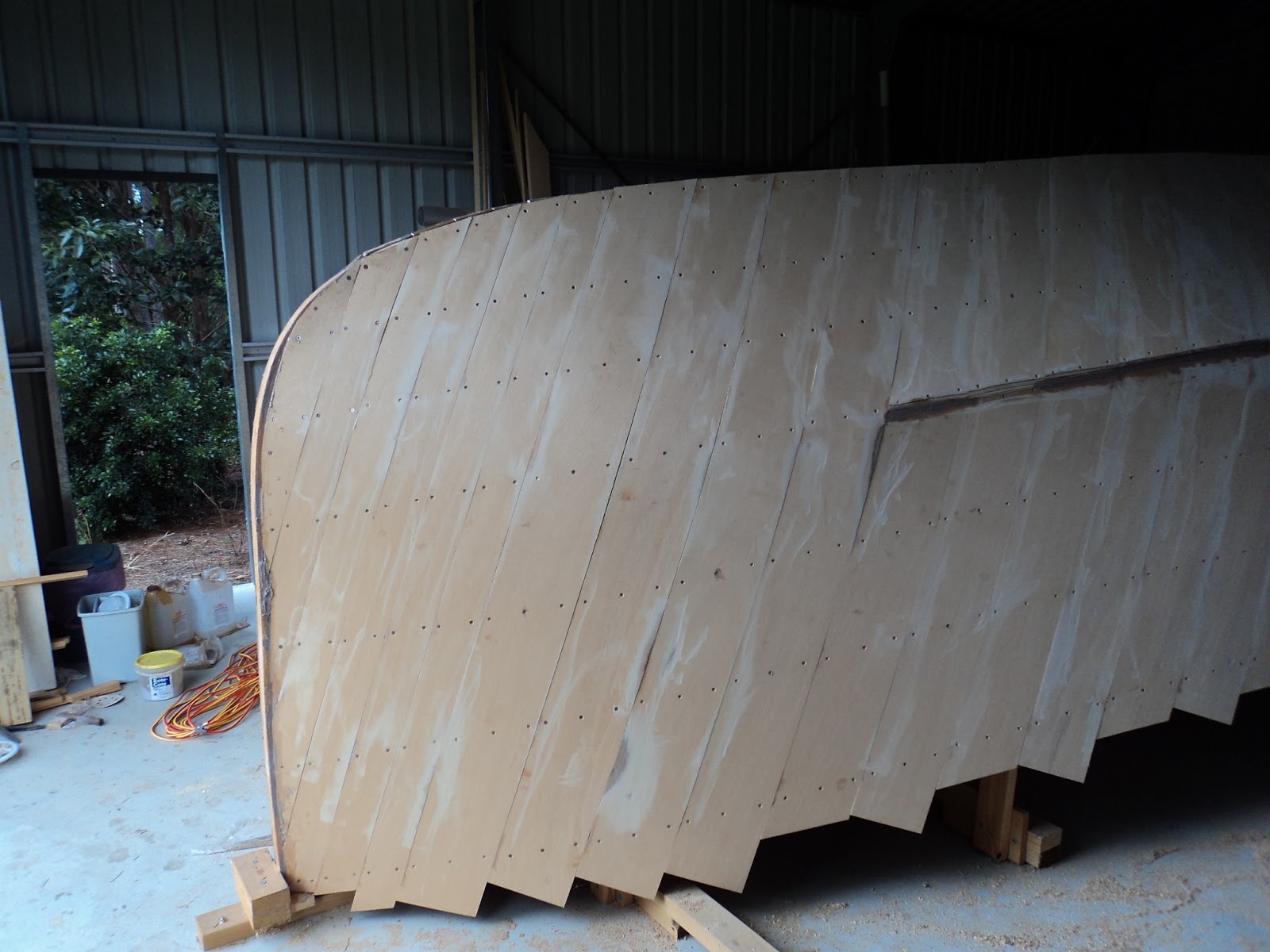
After finishing the prep it was time to put the last layer of ply on the hull.  First piece of ply is full width as the hull is not too wide .

Below is the first piece ready to attach, zig zag scarf on rear which is located over a hardwood cross piece on one of the frames:


In place from from the front:


And rear:


By now the bottom was wider than a single piece of ply, so marked the centreline and worked out each side.  There is another frame just behind where the above join is, I had to scarf extra onto a sheet of ply to make it long enough to reach a frame near the rear of the hull so decided to put the extra up the front where I can screw is down to both frames.

Below is preparing the joins:


Then gluing the scarfs:


Once that was done I could cut the zig zag joins on the end of the second pieces and trim the third pieces (almost a full sheet as well in length).  I dry fit them using a couple of screws front and rear only, drilled and countersunk all the remaining screw holes and put all the screws in place.

Below is looking rearward:


And forward:


Close up of one of the zig zag joins between the second and third sheets:


Screws across into hardwood cross pieces and along the join to the sides are 1" (25mm), 200mm grid in between of 5/8" (about 15mm) which if I didn't screw them in too far should not come through on the inside.

Epoxy on the first layer ready for the second sheet first half:


And finally some comparison shots.  Looking towards the transom from the back of the first sheet before:


And after all screwed in place:


You can just see in the photos that the joins on the first layer are covered by a solid sheet on the second.  No two joins are on top of each other in the two layers.

Next is to fill all the holes, trim the join between the sides and bottom in preparation for fibreglass taping the chine and bottom joins, and then the whole hull.

Thursday, 23 May 2013

Prep for second layer on the bottom

Now that the sides are finished it was time to get rid of the extra wood at the top where the curve meets the bottom, and also at the chine where the two curves meet.  Using an electric plane I took them down at the top until the sides met the bottom.  I think I may have a little bit more to take off but there was a lot of sawdust created.

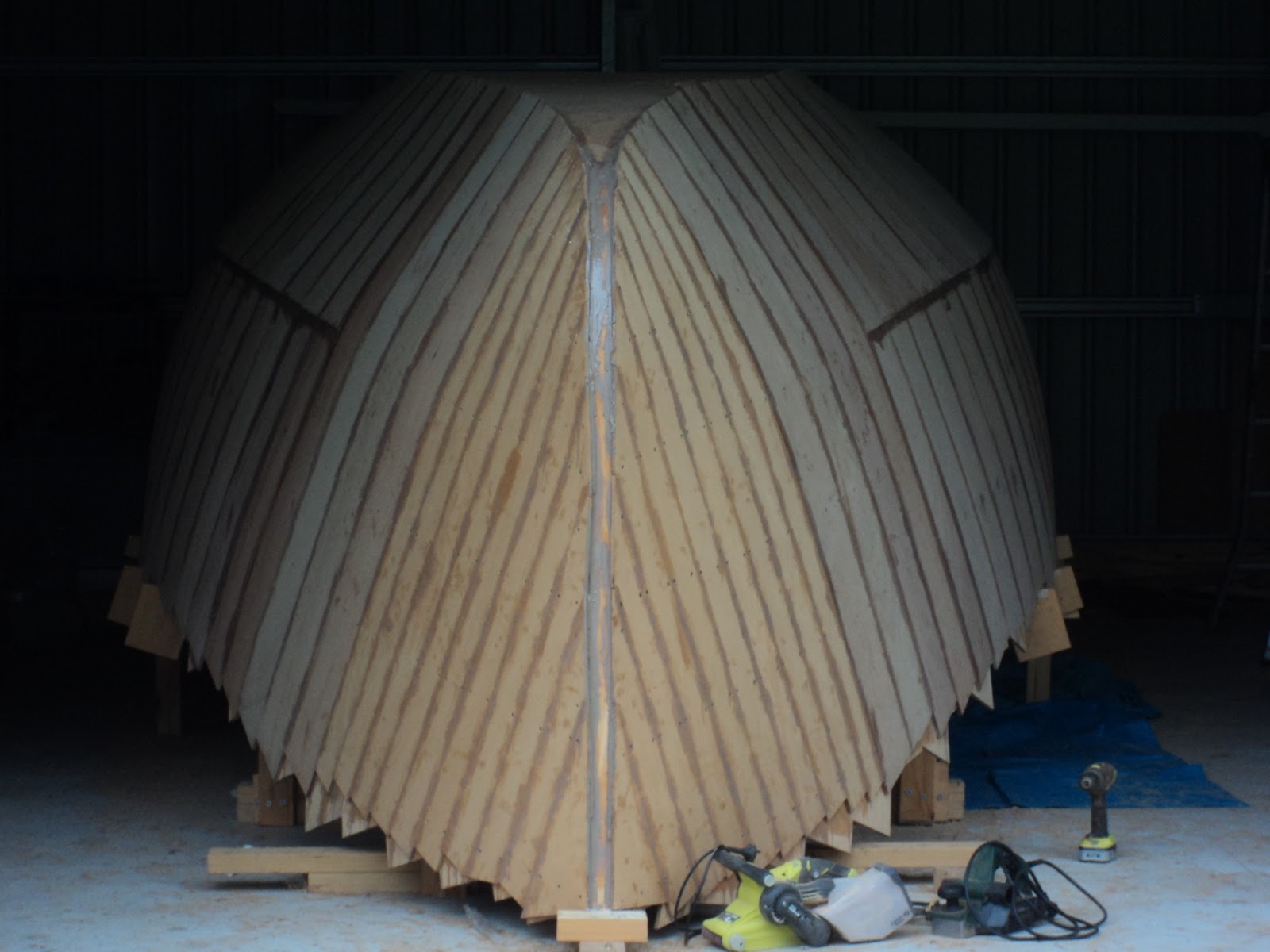
I started at the stem where I took the extra off at the front where it met the stem.  Below is the final result from the front before:


And after:


And showing where the stem meets the first bottom layer/sides:


At the transom looking forward at the top of the curved sides meeting the bottom before trimming:


And after:


Looking further forward:


And one of the zig zag scarf joints sanded ready for the second layer:


Next step is the mark the centreline and dry fit the second layer, the middle is wider than a single sheet of ply so you work out from the centreline each side until it narrows to within the width of one sheet of ply.  The joins in the second layer are over a different frame so the joins in the first layer are overlapped by a continuous sheet of ply, but you still join over a hardwood cross piece on the bottom of the frame.  This will make sense in the next post.

Friday, 10 May 2013

Second layer hull sides complete - planking detail

I have now completed the other side top curved section meaning the two layers on both sides are done.  After dry fitting and removing all the planks one day I epoxy/glued them in one go the next.  I increased to spreading epoxy/glue on four planks at a time resting on saw horses and seemed much quicker and easier.

Below are a few shots firstly from the front:


Looking down the side towards the transom:


Looking from the side at the transom:


And from the front:


Now that the sides are done I will include a few photos showing how the layers fit together.  Firstly the transom from a distance:


And below is a close up of the overlap between the layers, note that the top curve final layer is yet to be trimmed to a curve edge.  As you can see (as we look at them) the bottom curve is overlapped by the top first layer, which is overlapped by the bottom second layer and finally the top second layer.  Plenty of epoxy/glue with no voids that I can see.


The shot below shoes the two layers of the top curve where they overlap the ply bottom first layer.  This will be planed flat and then have a second flat bottom layer place over the top.


Planing the top curve to take the second layer of the bottom is next.


Saturday, 4 May 2013

Top curve first side

After tapering the top edge of the bottom curve section on both sides it was time to start the top curve.  The planks on this are smaller than the bottom one, so less epoxy and quicker progress.

I managed to work my way down the side dry fitting, the middle was high off the ground so had to resort to a ladder.

Here is the first half dry fit:


From the side:


I then continued to the transom and then took them all off again.  It is a bit sad how quickly a lot of time cutting, adjusting and dry fitting can be disassembled in.  I know I said I wouldn't do it again, but I epoxy/glued the whole lot in one go, only took four hours this time!

Looking towards the transom:


Looking down the side:


From the front slightly offset:


From a distance:


Thursday, 25 April 2013

Second layer Bottom Chine done

Planking of the second layer continues.  I will start with a few photo's of how I am fitting them.  The planks are dry fit first then removed.  Once you have done enough planks, generally about 8 to 13 I epoxy them in one session.

First you put epoxy/glue onto the hull:


Then onto the planks, I did two to three at a time.  The red plastic scrapers to the left of the planks I use for spreading the epoxy.  On the hull a flat one, on the planks I spoon the thickened mixture on then spread it with the larger one which has a series of notches cut into it.  Disregard the thin one, it was too small so I went with two large ones.


The you screw it on and repeat.  I found if you screw from the unplanked side towards the existing planks as you move across the screws it helps force epoxy across the plank and up through the gaps between the second layer planks.  This should help eliminate hollow sections between the two layers.

End result on the first side half done:


And the other side.  I did the epoxy of the entire length of the second side in one go but it was hard work over about four and a half hours.  Make sure you get inside and scrape away the extra epoxy that is squeezed out on the inside joins as well otherwise you will have a lot of work to do when you flip it.

From the front:


And looking across at the transom:


Next step is to plane the chine join for the upper chine to overlap.

Sunday, 14 April 2013

Second layer bow completed

After some minor sanding it was time to start the second layer.  I decided to do the front where the full length planks are and move back from there.  Firstly was the positioning of the first plank, which I lined up with the spot where the chine met the full length planks on the first layer but is placed on an angle toward the bow.

The process was the same as the first layer, but was a bit more effort as you can only clamp on the bottom and work your way up from there.  Four full width planks with three screws per stringer, 9 more narrow ones with two screws each stringer and a large piece to finish (some will be cut away for the bowsprit after flipping).

Wasn't too bad, used the screw lines of the first layer to line up the second ones, only hit a couple and had to re-drill the holes.  Did a full dry fit first each side prior to epoxy/glue, then pulled them all off. But make sure you run a pencil down the rear edge of the first plank and mark somewhere on the hull and plank to line it up.  On each one I also put a pencil line across the join so I could line the planks up on final fit.

From the front:


Below is the first side:


And a series of shots to show how it has changed along the way:


Next step is the lower chine curve (as we look at it) both sides to the transom.

Thursday, 4 April 2013

Layer one done - prep for layer two

Managed to epoxy and screw on the remaining planks to finish the first layer.  It looks exactly the same as the previous dry fit photos but I'm happy with that.

Prep for the second layer required the adjustment of the chine join for the second layer to overlap.  First I used an electric plane and then a belt sander lightly to tidy up.  I then went over both sides where a few plank joins were sitting up.

Below is the first side before, showing the overlap:


And after trimming the extra and sanding:


From further near the bow:


And after:


Looking from aft forward:


Below is a close up of the join.  The second layer on the bottom is next which will overlap this join:


Other side:


Looking towards aft, the dark at the join is drying epoxy/glue where there was a small gap to fill:


And an overhead shot standing on top:


Onwards to the second layer.